
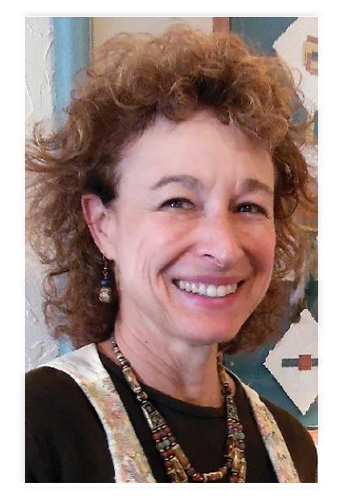
Beth Firestein, Ph.D.
Bi Health Summit
National Conference on Bisexuality
San Diego, California
August 21, 2003
Maya Angelou wrote a poem for Bill Clinton’s presidential inauguration entitled “On the Pulse of Morning.” Giving voice to the experience of disenfranchised African Americans and other minorities in this culture, Maya Angelou speaks of “Arriving on a nightmare, praying for a dream,” a feeling that many in our community can certainly relate to. Those of us attending today’s Bi Health Summit feel that we have our part in turning the nightmare of biphobia, homophobia, and sex-negative cultures that adversely impact bi health into dreams of courage and hope, equality and affirmation.
As Maya Angelou also says in this inaugural poem, “History, despite it’s wrenching pain, cannot be unlived, but if faced with courage, need not be lived again.” I find these words inspiring.
We are here to talk today about difference and unity, about accommodation and individuation, both inside of ourselves and within our professions. We are here to talk about the past and the future, about the contours of courage that will give us the hope of a better tomorrow for bisexuals everywhere. Most of us know in our bones that the original impetus of gay liberation was unity, not polarization. In 1977, Don Clark wrote,
“We who are gay can still love someone of another gender, and fully love someone of the same gender.” Gay liberation was about expansion and inclusion. Bisexuality was a seamless element n the fabric of gay life then—unnamed, unquestioned, part and parcel of the movement for sexual and emotional freedom.
The transition into identity politics has been a lengthy and complex 25-year journey, well documented by a variety of bisexual, gay, and lesbian authors. The affirming and disadvantaging aspects of identity-based theory and activism have affected by health and shaped the medical and mental health treatment of bi people in a number of brad and specific ways. Identity politics has led to the articulation of bisexual perspectives and to backlash from both gay and straight quarters.
Our further, uneven movement toward queer theory and queer “identities” (if there be such creatures), poses us with the potential obliteration of “bisexual” as a category of identity before it even has a chance to be validated as a “legitimate” identity category. This raises thorny issues about where bisexuals may wish to position ourselves in relation to these “queering” influences.
The pitfalls of articulating and reinforcing the concept of “bisexual identity,” while multiple, nonetheless creates a platform of equivalency that is probably necessary to the legitimization and systematic exploration of the distinct elements of bisexual experience. These have profound and enduring implications for bi mental health. Fortunately, there is no “either/or” here around the imperative of “queering bisexuality.” Bisexual healers, lovers, and activists can and should support one another in taking multiple positions in relation to identity-based research and queer politics. It is important to explore and demarcate fully all of these territories of knowledge and practice applicable to our needs and those of our clients. A lot of incredible work has already been done.
Ron Fox’s large scale study of bisexual identity development in men and women, Emily Page’s ground-breaking research on bi women’s experiences with mental health providers, Paula Rust’s 2001 Social Sciences reader on bisexuality, the emergence of the Journal of Bisexuality, and the bi leadership and bi inclusion in the development of Division 44’s Guidelines for Psychotherapy for Lesbian, Gay, and Bisexual clients are just a few of the amazing steps we have taken in “turning the nightmare into a dream.”
I think we are at an exciting juncture in the movement for bi health and there are several reasons for my excitement. First, we continue to have the opportunity to facilitate the paradigm shift from illness models of homosexuality to gay and lesbian affirmative models, and the further transition form gay and lesbian affirmative models to a LesBiGay/Transgender affirmative paradigm (Firestein, 1996), more inclusive in scope and more accurate in descriptive and predictive power than any prior paradigm.
Second, we are still in the early stages of the bi health movement—a period of time during when each of us has considerable definitional freedom and power. We get to name the terms of the discussion and frame the dialogue as a conversation rather than a debate. Key in this process, and reflected in the structure and content of this Bisexual Health Summit, is the continuous press to address bisexuality in it’s full complexity, integrating the perspectives of multiple, overlapping, culturally, ethnically, and otherwise diverse populations who embody behavioral, emotional, or identity-based bisexuality.
Of particular relevance to my recent experience in clinical practice is my own therapy and consulting work with cross-dressing, transgendered, and transsexual individuals, their relationship partners, and family members. I am finding a high incidence of bisexual exploration, redefinition of sexual identity in light of ongoing construction of trans-gender narratives, and frequent movement to openly embrace a bisexual identity among many of my transgender, particularly transsexual clients—both M-to-F and F-to-M.
A related phenomenon in my clinical practice involves the way in which my clients’ movement toward bisexuality impacts partners and spouses in their own sexual identities and self-definitions. In contrast to the situation of gender-conforming clients discovering their bisexuality, the ability or inability, success or failure of the partner or spouse in negotiating their own process of sexual identity redefinition is often what determines whether a primary, committed relationship will continue or end.
As clinicians, we cannot afford to remain ignorant or prejudicial in our work around issues of transgender, polyamory, kink, and other sexually diverse choices made by those we want to assist. It is our ethical responsibility to educate ourselves and to teach and train students and others in the mental health field to understand these issues and to develop the skills to intervene meaningfully, with individuals, couples, triads, and expanded family communities who are pioneering in the shadow of these challenges.
In my recent practice, I have worked with several transsexual clients coming out as bisexual, both within and outside of traditional, heterosexual marriage. I have worked with a bisexually identified heterosexually married per-operative transsexual client actively seeking to form a triadic relationship (expanded family) by expanding her (formerly) heterosexual marriage to include an outside male partner with whom to share their lives. I also recently worked with a kink-oriented bi woman dealing with family of origin issues while transitioning her involvement levels in multiple, overlapping intimate relationships simultaneously.
A powerful and defining aspect of my work is to continuously challenge myself to effectively discriminate between “deviance” and “difference,” between pathologically-motivated behavior and unconventional choices that function as creative solutions to the dilemmas of living complex, multi-layered identities in a conservative, binary culture. This often puts me in the uncomfortable position of evaluating and defining the healthy and problematic aspects of others’ behavior because to uncritically support all clients in every choice can be just as damaging to these individuals as forcing every unconventional client into the Procrustean bed of Puritan monosexuality. Our clients trust us to provide meaningful criteria by which to evaluate the health of their own functioning and the health or dysfunction of relationship and partner behavior, yet we must do this without crossing over the line of respect for client autonomy by “telling them what to do”.
This adds urgency to our present dialogue in this Bi Health Summit. We need to forge new conceptualizations and interventions grounded in appropriately critiqued personality theory, an understanding of behavior change, and approaches consistent with our values, ethics, spiritual beliefs, and political commitments. Such practices will also be positioned in specific, yet dynamic relationship to sexual orientation theory and evolving concepts of sexual and gender identity.
It is a fun and exciting time to be a queer/bi mental health practitioner. Other issues of current interest to me in my clinical work with bisexual people include:
- Helping clients manage heterogeneous social circles and identities;
- The broad issue of accommodation versus individuation, as these play out in the lives of my bisexual and gender diverse clients;
- Visibility and invisibility, including the implications of “passing”—choices, options, and strategies;
- As mentioned earlier, implications of “queering” bisexuality. This affects us as therapists helping bi clients come to self-understanding;
- The constant challenge of sensitively and effectively attending to the racial, sociocultural, educational, religious, and cultural complexity and diversity within bisexual identities and experiences;
- The issue of multidirectional partiality, a theoretical term from family systems approaches that speaks to the therapist’s need to balance loyalties to various family members within a client family in a non-prejudicial way when counseling multiple members of a family. I find this particularly challenging in the arena of working with trans-bi clients in relationships with straight-identified spouses coming in for relationship or marital therapy.
Jay Paul (p. 11) writes that, “Researchers have imparted an artificial consistency to an inchoate sexual universe.” At the risk of implosion, or the dissolution of focus in what we now understand to be an “ever expanding universe of sexual and relational possibilities in an ever-expanding universe! (smile), let us take care not to do the same. Let us strive to embrace complexity without falling into the abyss of atheoretical support and poorly guided intervention. We skate the thin ice of politically driven clinical activism and clinically driven political research, working to align our values, our ethical commitments, and what we know about mental health with our own experiential realities and the needs and desires of our clients.
If we succeed, we map the contours of new frontiers in bisexual health. We cannot afford to fail. A new aesthetic of healing and creative clinical engagement beckons our conscious and unconscious participation. In Maya Angelou’s words, “The horizon leans forward offering you space to place new steps of change. Lift up your eyes to this day breaking for you. Give birth to the dream.”
1 Part of a panel on Bi Mental Health and Community Outreach. Panel participants included Beth Firestein, Ph.D., “Fuji” Collins, Ph.D., Emily Page, Ph.D., and Geri Weitzmann, Ph.D.
References
Angelou, M. On the Pulse of Morning. (poem)
APA Guidelines for Psychotherapy with Gay, Lesbian, and Bisexual clients.
Firestein, B. Paradigm Shift chapter in Bisexuality
Fox, R Study of identity
Page, E. (in press) Bi women in Therapy
Paul, J. ( ) p.11?
Rust, P., Ed. (2001). Bisexuality in the United States: A social sciences reader